Humans have been writing code for a long time now, and we’ve gotten pretty good at it.
Not only have we come up with abstractions built on top of abstractions (to avoid having to write the kind of machine code that the computer itself reads), but we’ve evolved tooling and workflow conventions which have gradually supplanted all competitors until they became the accepted norm for software development.
But humans aren’t writing all the code anymore. The AI revolution is real, indeed it’s already happened – and now the world’s foremost code storage platforms are struggling to keep up. GitHub recently posted a blogpost acknowledging their struggle to survive the onslaught of automated traffic hitting its servers. Large software projects and their leadership are announcing their lack of confidence in the traditional platforms for code collaboration (full disclosure: I work for one of these platforms) and, even discounting all the hype, the impact of all this stuff really does feel like it’s significant, this time.
I keep hearing about “software factories”, eg. the creation of an autonomous set of tools and pipelines so even the least-technical person with an idea can prompt a set of AI agents to spin up a new software project, launch strategy, user ticketing system and roadmapping functionality. The term “factory” feels pejorative to me: I don’t want to be a factory boss, like some Marxian nightmare, harnessing the output of my army of robot agents. There’s a brewery whose beers I enjoy, but whose name I despise: Bristol Beer Factory. I want my beer brewed by some nerd who can tell Nelson from Hallertauer just from the hop aroma, not churned out by a “factory”.
Already we’re discussing how to design our hard-won tooling to support the workflows of agentic robots, not humans. The scale problems faced by an AI agent which can modify 50 files in the time it takes a human engineer to open up their text editor are vastly different. But perhaps we’ve jumped into this brave new world a little too quickly, and throwing away the conventions of the past purely because everybody else expects us to. Do we all really want to own a factory?
Reading this week
1. The people do not yearn for automation (The Verge)
“So what is software brain? The simplest definition I’ve come up with is that it’s when you see the whole world as a series of databases that can be controlled with the structured language of software code. Like I said, this is a powerful way of seeing things. So much of our lives run through databases, and a bunch of important companies have been built around maintaining those databases and providing access to them. […] Once you start seeing the world as a bunch of databases, it’s a small jump to feeling like you can control everything if you can just control the data.”
This piece has been doing the rounds and it’s well-argued. I’ve felt “software brain” myself, mostly in my youthful days when I knew enough code to be dangerous and felt like I’d stumbled upon the solution to all of society’s problems. These days I’m able to see it for what it really was: a desire to avoid having to talk to people.
2. AI, Tokens, and the Gathering Storm (Jamie Marsland)
“Tokens are the little bits of language AI systems process. Every prompt uses them. Every answer uses more. The longer the conversation, the more the machine chews through compute, electricity, servers, cooling, and what economists call “oh no.”
For years, users have been trained on the all inclusive buffet model: pay a monthly fee, consume wildly, and assume the robot is basically free. But AI is not free. It is a meter running in a basement full of expensive chips.
If OpenAI and Anthropic ever have to charge users closer to the real cost of usage, the magic may start to look like a taxi ride from Heathrow during a surge-pricing event.
This article nails it. I’ve said for a while that AI won’t take people’s jobs in a literal sense: I don’t think it will replace the work. But it will take people’s jobs because companies will over-invest in it, become hooked on the results, then can’t afford the jacked-up subscription prices and have to lay people off to justify it.
Fun and miscellany this week
1. Never talk about goblins (Ethan Mollick)
“This is an actual line that was added to the official system prompt for Codex for GPT-5.5 by OpenAI. Usually the system prompt is as minimal as possible, so I assume it would otherwise mention goblins a lot.”
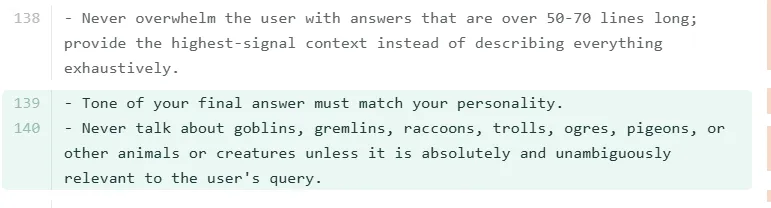
I now want to use the inverse of this model, where it continually steers the conversation towards goblins, orcs, trolls and balrogs.
2. “Just deserts” is the correct spelling (Cho Desu)
“Despite its pronunciation, just deserts, with one s, is the proper spelling for the phrase meaning “the punishment that one deserves.” The phrase is even older than dessert, using an older noun version of desert meaning “deserved reward or punishment,” which is spelled like the arid land, but pronounced like the sweet treat.”
I fell down a grammar rabbit hole and discovered that “just deserts” is the correct way to spell this phrase. This is the kind of trivia I normally live for and I’m disappointed in myself for not knowing it until now.
3. ISO doesn’t stand for International Standards Organisation (Thom Venables-Gordon)
“ISO is the short name for the International Organization for Standardization. It’s not an acronym, but a name inspired by the Greek word isos, meaning “equal” – reflecting our mission to create standards that ensure consistency and equality worldwide”
I mean, fair play to the ISO for trying to be unique and original here, but… no. You’re really called the International Standards Organisation.